Sign up for WAE Emails


“Water- a bequest of nature” bases all innovations in curbing water crisis to make our blue planet green and sustainable.

All of the life on Earth, from Archea to Axolotls, bacteria to blue whales, is made mostly of water. Every dynamic process in cells, every biochemical reaction needed to keep things alive, moving and growing, depends on water. Ironically, something so copious, indispensable and life-sustaining is used so heedlessly that one-third of the world’s biggest ground water systems are already in agony.
As Herodotus said, Egypt is the "Gift of the Nile", which ruminates that historically, it was water that determined the location of human settlements. People have been dependent on the munificence of nature far more than we can imagine. As civilizations evolved, the dependency on water also snowballed and with the growing technologies to boot, water usage leaped a thousand-fold.
From morning ablutions to generating steam power and electricity, all entail water. But do we have enough water obtainable on earth to accord with our soaring demands?
One could simply assume that water shortage shouldn’t be a concern for humans when bearing in mind the great expanse of water which is 326 million cubic miles of incessant, limitless seas and oceans ensconcing in between our seven continents.
With merely 5% of the ocean floor having been mapped, water seems to be as abundant as it is ominous. Of the waters seizing 70% of the earth’s surface, only 3% is considered fresh water and about 2.6% of this freshwater is inaccessible for humans into the bargain. They’re either locked up in polar ice caps and glaciers, stored in the atmosphere or soil, highly contaminated or too far-flung, beneath the earth’s surface to be extracted.
This leaves us with roughly 0.4% of the earth’s water to be doled out among 7.7 billion of its inhabitants to meet the swelling water demands. And still, much of this 0.4% is unget-at-able.
The amount of water that has been there on earth since the dawn of time is same as that which has been incessantly flowing through Earth’s natural hydrological cycles, not a drop more or less. What has changed is the populace on earth, and inevitably, the amount of potable water needed for sustenance. As its demand is booming, the need for sustainable and cost-efficient solutions has become imperative.
Keeping in mind, the disconcerting increase in pollution and the thriving population to boot, new technologies have come up to meet the ever-growing demand of potable water.
Thanks to the piercing heat in summers, our bodies are inescapably drenching in this never-ending humidity. But, what if, this throttling humidity could be put to use for current and future water needs?
In the recent years, experts in the water industry have emerged with technologies that could convert it into a commodity- Atmospheric water generators!
Wondering how?
The air that we breathe is made up of numerous gases including water vapor. The term humidity refers to the amount of water vapor in the atmosphere. This vapor can be used in two ways to produce potable water. The first encompasses dehumidifying the water vapor, condensing it and then ultimately collecting and purifying it to make potable water.
Ever seen water dripping from your air conditioning unit? Well it’s because of dehumidification only. While Its core function is to cool a room, in order to do that, it pulls the air into the system and runs it over refrigerated stainless-steel coils which condense the water vapor, dispelling the moisture out of the air conditioning unit.
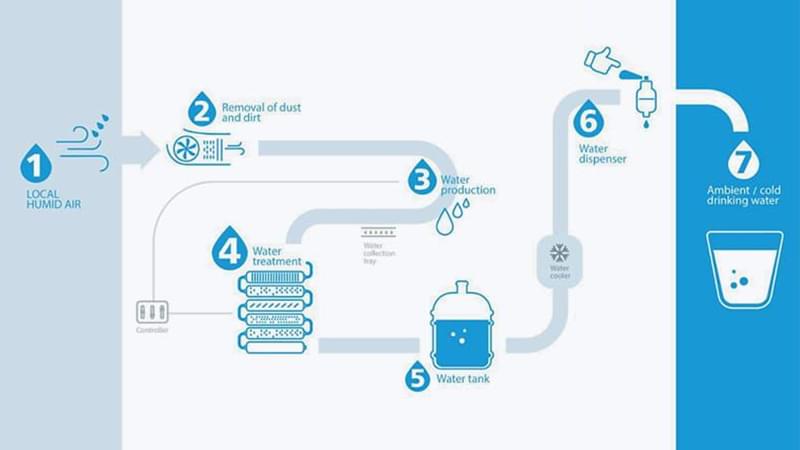
Atmospheric water generators might sound cumbersome and bemusing but work along the same lines as air conditioners and dehumidifiers. The air containing water vapor moves through the condenser and evaporator coils. While evaporator dehumidifies the vapor, a condenser dumps this heat outdoors.
A refrigerant flows through these loops which readily absorbs heat energy, shifting from vapor to liquid state and back again. It flows from the evaporator coil through the system compressor to the condenser coil, snaking back to the evaporator. The water collected is then filtered a number of times with a purification system in order to make it potable.
The amount of water produced depends on the relative humidity in the air, the size of the compressor and the ambient air temperature. If the relative humidity is below 30%, the atmospheric water generator doesn’t work efficiently.
The other technique entails dehumidification with a liquid desiccant method. Desiccants are chemical substances that have a natural tendency to absorb atmospheric moisture. In desiccant based water generators, humid air passes over a salt mixture (Salt, being a natural desiccant). The wet salt is then heated to the boiling point and the steam is condensed and routed to filters for processing. The key benefit of desiccant technology over vapor compression is that it is more effective at low humidity conditions and is fuel efficient!
Seeing the escalating demand for potable water, a plausible hydration solution like this would go to places! This machine needs nothing but atmospheric air to generate pure drinking water which makes it a sustainable source of consumable water! Furthermore, it has no perilous effects on the environment and solves the problem of water scarcity into the bargain! All one needs is a source of power to operate it!
Atmospheric water generators are even free from fecal contamination as well as natural and manmade contagions which groundwater stomachs. The impurities in the air can be easily removed with modern technology! Moreover, this future forward solution does not need extensive backend infrastructure which is required otherwise!
Researches indicate that, at any given instant, the atmosphere contains 37.5 million gallons of water vapor, and experts have found out a way to use this humidity as a commodity for our current and future water needs.
These newfangled machines are not just energy saving but cost efficient too! While the immediate cost may seem expensive, the net gain outweighs it within a short period!
The Atmospheric Water Generator can be used to provide drinking water in community centers, residential complexes and public places like health care centers, schools, colleges, offices, railway stations, airports, military establishments, remote field areas. Its portability makes it accessible in many emergency locations, such as hospitals, police stations, or even shelter for survivors in a natural calamity.
However, like any other technology, these water generators too have their own hitches. This technology depends on the location and the amount of relative humidity in the air which makes it useless for areas with relative humidity less than 30%.
Even though atmospheric water generator is a long-term feasible investment, it still is cost prohibitive as the immediate expense is too high. Furthermore, this technology is not fully proven as its basics hark back to air conditioners and dehumidifiers.
With a whopping gap of 40% between water availability and its demand, a technology like atmospheric water generator needs nothing but apperception to flourish. As Cape town has already offered a cautionary tale for the whole world, other cities around the globe need to take a que from that before things get out of hand. From Mexico to Armenia, Turkmenistan to Belgium, water supplies are continuing to shrink, and different parts of the world are facing a looming crisis.
As demand for fresh water is becoming unmanageable with each passing day, the hour has come to attempt and find economical, effective and sustainable practices and solutions to tackle water meagerness. It has become exigent to develop cost-effective and energy-saving technologies to produce sanitary and salubrious potable water for the masses. With the ever-approaching menace of exhausting the world’s supply of fresh water, Atmospheric Water Generators have been fashioned to tackle the water problems and the imminent crisis.
END

In our minds, we almost instinctively associate the word ‘Cotton’…

As individuals and as a community, we need to be…

PoU water dispenser purifies waters through reverse osmosis and comprises…

The concept of drinking water fountain is new to India,…

