Sign up for WAE Emails


“Water- a bequest of nature” bases all innovations in curbing water crisis to make our blue planet green and sustainable.

What’s your first instinct when you wish to check if certain drinking water is clean? You look for its transparent form, don’t you? But how accurate is this parameter? Yet, you often consider that if there are no floating particles and no coloration, it must be pure.
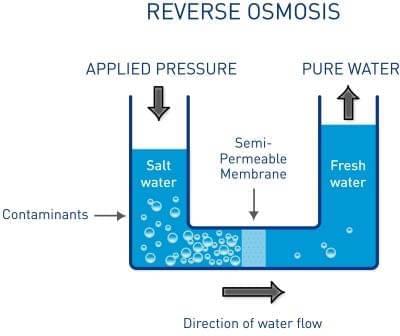
Water can be regarded as pure and safe to drink when it is not only free of visible impurities but also of the soluble and invisible impurities. Reverse osmosis is a water purification process which ensures just that. It involves passing the water through a semi-permeable membrane and carbon filters which separate dissolved salts, organics, bacteria, pyrogens and other volatile compounds from the water. This helps in bringing the TDS (total dissolved solids) level of water to the WHO prescribed range of ≤ 500 mg/L.
What makes the RO system efficient?
Apart from making the water free of contaminants, there are several other advantages of an RO system that advocate its excellence.
• RO systems consume less amount of energy on account of energy recovery devices being used in the process.
• These systems are space saving as well as expandable so you can tailor your choice according to your need.
• Also, RO systems are quite easy to maintain. Filter replacement is one of the things that you need to check on every six months. The overall maintenance of your purifier depends on how much you use the system and how polluted the water is.
• When the water gets rid of the chemicals, it naturally tastes more refreshing and satisfying than otherwise.
• Reverse osmosis comprises seven stages and the effectiveness of the system increases with each stage. You can customize your system based on what kind of treatment the water in your area needs.
Science endorses RO system You might have always wondered what really happens to the water inside those three cylindrical canisters of an ROpurifier.
Here’s the feed.
• Reverse osmosis starts with making water good and then making it great. This helps in avoiding excessive clogging in the primary carbon filter thus conserving the membrane.
• Involves removal of larger sediment like dissolved salts and reduction of chlorine.
• Water with hardness <10 grains per gallon is suitable to be treated in an RO system. If the hardness is more, the installation of a water softener is recommended.
2. The reverse osmosis membrane
• After filtration, the water is forced through an SPM under pressure. Here, sodium, chlorine, calcium and other larger molecules like glucose, urea, bacteria, and viruses get removed.
3. Post filtration
• The water then goes through a second carbon filter which removes any remaining traces of contaminants and then gets collected in a tank.
4. Final polish
• Before it comes out of the faucet, the water passes through an in-line activated carbon filter and hence gets free of any odours or flavours of system hoses or the collection tank.
Considering the entire buzz around water scarcity, it’s a no-choice situation to somehow treat the available water and make it potable. RO systems waste at least equal or twice the purified water in the process. Hence, ZeroWaste technology has come to the forefront which focuses on the treatment/ usage of concentrated water to achieve 100% efficiency. Also, considering energy conservation, renewable energy powered water desalination systems are the need.
Technology is constantly improving
More advancement in this field is being made to increase the efficiency of the technology in terms of cost, quality, waste generation etc. Thin film composite membranes have been developed that are resistant to bacteria breakdown and have a high rejection rate of 95-97% on average. Photovoltaic RO technology has been introduced to increase Energy efficiency of the system. However, the costing is high due to additional problems of failure of batteries, invertors etc. To lower this cost, standard commercial units have been introduced. Hitherto, RO technology has proved to be more efficient than any other domestic purification techniques. It’s time to embrace it.
END

In our minds, we almost instinctively associate the word ‘Cotton’…

As individuals and as a community, we need to be…

PoU water dispenser purifies waters through reverse osmosis and comprises…

The concept of drinking water fountain is new to India,…

