Sign up for WAE Emails


“Water- a bequest of nature” bases all innovations in curbing water crisis to make our blue planet green and sustainable.
Have you ever wondered where do companies, selling bottled water, get the water from?
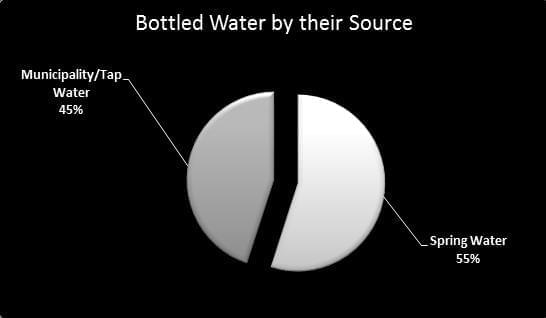
A study by Peter Gleick (an American scientist working on issues related to environment) showed that 55 per cent of bottled waters are actual spring water; the remaining 45 per cent are purified and treated tap water!
Ultimately, the company branding themselves and marketing their water as ‘fresh from the springs of xyz’, could very easily have their plant set up in an industrial area that gets municipal water supply.
Fret not – this isn’t that big a scandal. Essentially, it is redundant for every bottled water company to have their plant set up near a fresh water source, to be called ‘bottled at source’. There aren’t that many fresh water sources around anymore and the demand for bottled water keeps reaching new heights each passing year.
The bottled water industry has been pushing the narrative that suggests water, when sold in bottles, is purer than any other source of water in general. It is an organisation of capitalist moguls that picked up a non-commercial means of survival and objectified it in the market as a product to be sold alongside artificial drinks, as a beverage. Not only is the industry responsible for a fatal environmental footprint, but also fooling the public and making money off of something that exists naturally. We’ve come to an age of human life on this planet, where water cannot be considered available in abundance for everyone to consume. Fresh drinkable water is obtained from natural fresh water lakes, natural springs and ground water tables. Water as a resource is available in communities through various municipalities; this water is tested before being supplied into households. This is basic tap water; which unbeknownst to the fast-moving modern population is also as safe to drink as the water in bottle that you pay for. However, there is a process that entails the production of the bottled water.
Many companies employ a policy of transparency when it comes to their manufacturing processes. Brands such as Aquafina, bottled by PepsiCo; or Dasani by the Coca Cola group, use municipal tap water which goes through a lengthy filtration process before packaging. Gleick also tweeted the owner of Nestlé with some questions about the Poland Spring bottled water. He outwardly asked to know the percentage of source-extracted water from the alleged spring in Maine. The answer is not that unsatisfactory; about one-third of the bottled water is actually from the springs of Poland. Most consumers of this targeted marketplace are unaware of the source of their water; a loophole best enjoyed by companies as it is not demanded by law to mention the source of water on the label of your bottled water. This is a sham for this billion dollar market; catering to billions every day. One regulation however, exists very firmly; for a bottled water to be classified as ‘spring water’, it must be collected from a source of running water naturally flowing out of the earth’s surface or by means of a drilled borewell, tapping into the underground water table. For brands marketing their water as ‘glacier water’ or ‘mountain water’, the regulations are even scarcer. Bottled water is basically tap water, but it goes through various different processes before it reaches the hands of its targeted customers. The case of environmental hazards aside, one thing can be said for sure about this industry; bottled water is a highly regulated product. Every bottled water product- be it from a groundwater or public water source utilise a multi-barrier approach. This approach is prevalent here to prevent potential harmful contamination of the finished bottled water, between production, packaging, storage and the ultimate transportation of it.
The following measures are taken in a multi-barrier approach:
1. Source Protection
2. Source Monitoring
3. Reverse Osmosis
4. Distillation
5. Micro-Filtration
6. Carbon Filtration
7. Ozonation and
8. Ultraviolet (UV) Light
Here is an image source taken from the website of Nestle Waters showcasing the quality process of production for their bottled water.
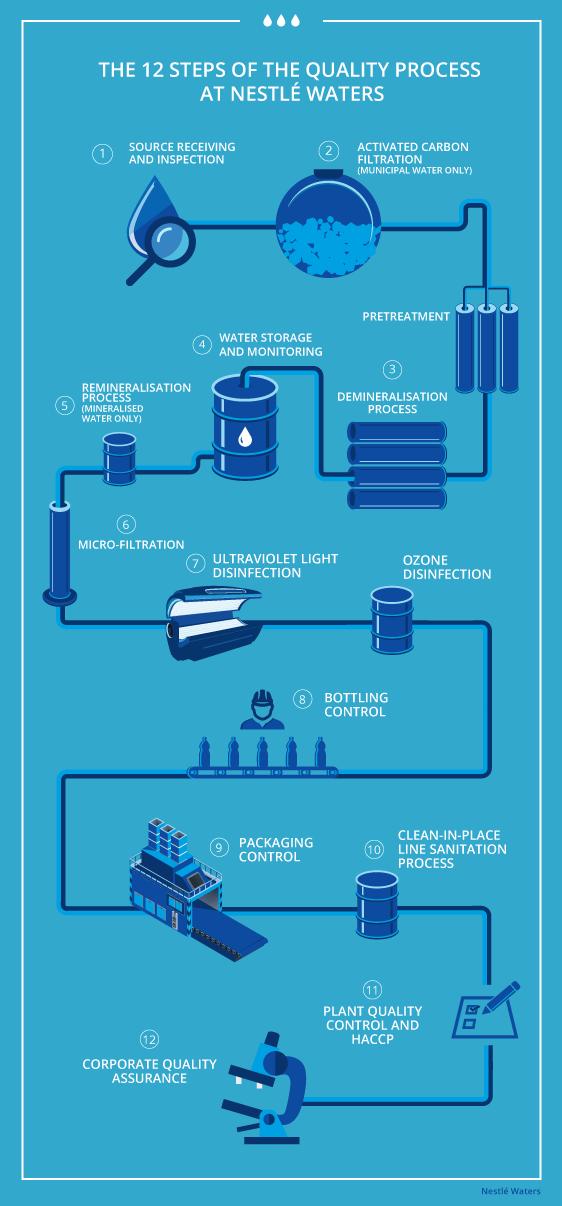
As intrinsic as Nestles’ process of production and filtration of water may be, it is still exhausting excessive energy, water supply in industries and work force over something that should not need so much processing. This in turn is not very efficient when it comes to current world environmental issues of ozone depletion, pollution, and global warming.
A Pacific Institute study shed light onto the following estimates:
17 million barrels of oil (not including the energy for transportation) equivalent is the amount of energy expended on the production of bottled water.
The industry renders more than 2.5 million tons of carbon dioxide in the production process itself.
It takes somewhere around 3 liters of water to produce 1 liter of bottled water.
In recent years, 20,000 water bottles are being produced every second. Most of this water is sold in polyethylene terephthalate (PET) bottles, a million ton plastic industry, solely for making bottles.
Another form of bad service rendered to the environment is done in the form of depletion of fossil fuel sources like natural gas and petroleum, to make these PET bottles.
Excess energy needs to be expended in order to fill the bottles with water at the factory.
Transportation; storage in warehouses and stores; the recovery and recycling of bottles needs more energy.
Most of the plastic collected for recycling is not recycled. It ends up either in trash dumps or in the oceans. A recent study shows that eight million metric tons of plastic waste ends up into the oceans every year. A large percentage of this plastic waste comes from the use of PET bottles. The bottled water industries, alongside artificial beverage companies are the sole responsible organisations, which contribute to this archaic waste management system. The bottled water industry is exhausting non-renewable sources of fossil fuels, wasting water in the process of producing water and leaving a hazardous environmental footprint in the process of waste management.
As an individual, one cannot take on these corporate giants, who can crush the common man in the court of law with expensive lawyers. However, someone very important said something along the following lines; ‘To change the world, one must think globally, but act locally’.
As an initiating step, start carrying your own water bottle when you leave the house, to ensure that you personally do not contribute to the environmental hazards imposed by the bottled water industry. Another way to promote a healthier water habit is to install a water filter at home to avoid drinking microbial tap water.
Every drop counts and it is with multiple falling drops, which eventually and gradually fill up a bucket with water. Let’s aim to bring about a change, but gradually!
END
In our minds, we almost instinctively associate the word ‘Cotton’…

As individuals and as a community, we need to be…

PoU water dispenser purifies waters through reverse osmosis and comprises…

The concept of drinking water fountain is new to India,…

